 Snorkel Coiba
Coiba is nicknamed the "baby Galápagos" — and it's not only because of the sharks and turtles. Beneath the sea, Coiba and the Galápagos are joined by a real geological story: the Coiba Ridge and the underwater chains reaching toward the Ecuadorian archipelago most likely formed from the same volcanic hotspot: the Galápagos hotspot. Here's what science has found, explained without the jargon.
What is a volcanic "hotspot"?
Picture a still candle under a slowly moving sheet of paper: the flame burns a row of marks. A hotspot works the same way. It's a column of hot rock rising from deep inside the planet, staying more or less fixed while the tectonic plates slide over it. Each time the crust passes over the hotspot, a volcano erupts — and over time a chain of islands and seamounts forms. Hawaii is the most famous example. The Galápagos hotspot is another, and it's the star of our story.
The Galápagos, Cocos, Malpelo… and Coiba
The Galápagos hotspot didn't only create the Galápagos Islands. Over millions of years, as the Cocos and Nazca plates slid across it, it left a trail of underwater ridges on the Pacific floor: the Cocos Ridge (reaching Cocos Island in Costa Rica), the Malpelo Ridge (toward Colombia) and — according to geological studies — the Coiba Ridge, off Panama. They're like the marks left by that candle: different islands and mountains, one same source of fire.
There's even a "Coiba plate"
The connection is so real that geologists have identified a tectonic microplate called the "Coiba plate", a small piece of crust off the southern coasts of Panama and northwestern Colombia, named precisely after Central America's largest island. It borders the Cocos plate to the west and the Malpelo plate to the south — the very puzzle pieces that connect the whole region to the Galápagos. For years it was thought to be part of the Nazca plate; today it's studied as its own unit.
An honest nuance: scientists still debate the exact origin of the Coiba Ridge. Some studies link it directly to the Galápagos hotspot; others propose it was uplifted beside a major fault. Science keeps investigating — and that's part of what makes this region fascinating.
The link you can see today: the underwater highway
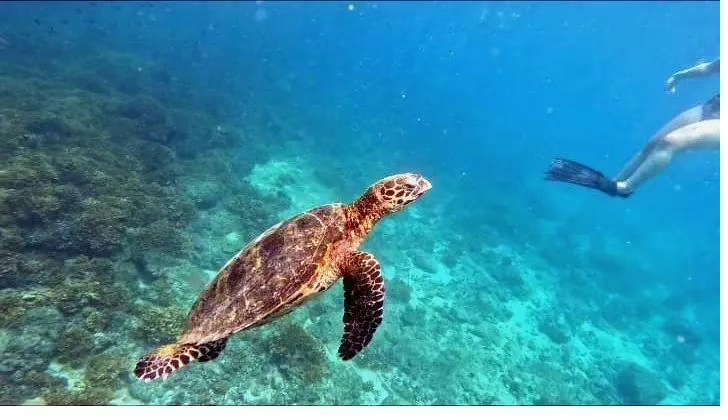
This is where ancient geology becomes present-day life. That chain of ridges and seamounts forms today a migratory corridor — nicknamed the "Cocos-Galápagos Swimway" or "shark highway" — connecting Coiba, Cocos Island, Malpelo and the Galápagos. Hammerhead sharks, whale sharks, green and leatherback turtles, and rays follow these seamounts like signposts along a road, migrating between marine reserves across hundreds of kilometers. The same geological structure born of fire millions of years ago is today the route of the Pacific's great animals.
Why does this matter for your visit?
Because it explains why Coiba feels like the Galápagos: the same volcanic origin created deep rocky reefs and nutrient-rich waters that draw the same kind of spectacular wildlife. The difference is that Coiba is a day from Panama City and a tour costs $75 instead of thousands of dollars. When you dive in here, you're not seeing a cheap copy of the Galápagos — you're seeing another branch of the same geological tree, just as real and far more accessible. If you want the full comparison, see Coiba vs Galápagos.